Source Gray Car Dashboard Trim Panel for Appliances, Cars, and Home Use
Find and compare 30 listings for gray car dashboard trim panel solutions. Options include IML IMD membrane layers, POM materials, and custom OEM/ODM services for household appliances, automotive interiors, and decorative panels with low MOQ availability; compare the available evidence and request quotations based on your requirements.
Key considerations
Products List




Comprehensive Sourcing Guide
Gray Car Dashboard Trim Panel Sourcing Guide
Sourcing a gray car dashboard trim panel requires balancing aesthetic integration with the technical demands of in-mold decoration. Gray remains a neutral baseline color for automotive interiors, which makes it a common request for both car instrument control decorative panels and household appliance control decorative panels produced with IML/IMD processes. Buyers should approach these listings as customizable product families rather than fixed catalog items, since the observed product pages describe models such as "Custom IML IMD Dashboard Panel," "Custom IML IMD Dashboard Cover," and "Custom IML IMD Panel Service."
This guide walks through the decisions that matter most when evaluating these listings: defining the product scope, verifying technical specifications, requesting compliance documentation, understanding cost drivers, qualifying suppliers, and setting up long-term procurement checks. Because customization is explicitly available and OEM & ODM orders are accepted, your specification discipline will largely determine whether the finished panel matches your vehicle program's requirements. Treat listed attributes as a starting point for discussion with suppliers, and confirm every critical parameter in writing before placing production orders.
Product Scope and Observed Listing Signals
The observed listings cover several related product types under the IML/IMD umbrella: dashboard panels, dashboard covers, general panels keyed to "Instrument Panel," and car interior panels. The structural build described for the dashboard panel is a membrane layer plus ink layer plus plastic layer, produced through a printing, 3D forming, punching, and injection molding sequence. This construction is what delivers the rich color patterns and flexible design freedom that buyers typically want from decorated trim, so confirm which layer stack and process route applies to your specific variant.
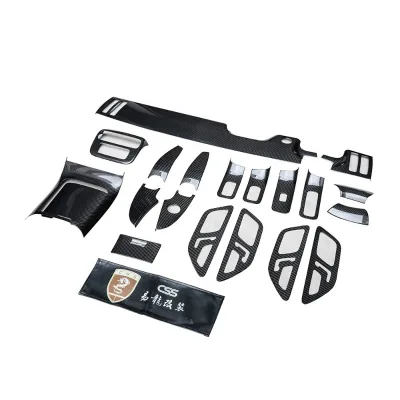
Listing signals also point to different commercial formats. One family of models (KJ-54, KJ-55, KJ-64, KJ-65, KJ-68, KJ-69) appears in colors such as natural, red, light blue, and pink, with POM material and 1000-piece MOQ formatting, suggesting small molded components rather than full dashboard faces. By contrast, a model BENZ152 described as w223 carbon fiber interior trims, with decoration plus protection function and original car hole installation at a 1-set MOQ, targets vehicle-specific retrofit trim. Clarify which category your gray panel belongs to before comparing quotations.
Technical Specifications to Verify
Begin with material and molding data. The listings reference injection molding with liquid thermosoftening plastic for the dashboard cover, and POM for one panel family, but your gray dashboard trim panel may specify a different substrate depending on heat exposure and structural requirements. Verify the exact resin grade, the plastic form, and whether the IML film system (membrane, ink, and plastic layers) is compatible with your resin choice. Also confirm dimensional units—the listings use millimeters—and require 2D drawings with tolerances for mounting holes and finished edges.
Next, pin down appearance and performance criteria. The listings claim wear and scratch resistance, strong durability, and environmental protection, but these are observations, not guaranteed test results for your part. Request color standards for the specific gray tone you need (a physical master plaque or an agreed color reference), gloss level, grain texture, and the punch/injection quality expectations for visible surfaces. For functional trim, ask how the supplier validates wear and scratch performance on your actual design, and whether samples from the production process route—printing, 3D forming, punching, injection molding—are provided for approval.
Compliance and Safety Documentation
Dashboard-adjacent trim sits in a cabin environment, so environmental claims deserve documentation rather than acceptance at face value. The listings state environmental protection as a product characteristic; ask the supplier to specify what this means in practice—which substances are restricted, what material declarations they can provide, and whether the ink and film layers used in the IML stack come with their own compliance statements. For any part installed in a vehicle, clarify which regional requirements your program must satisfy and request the supplier's evidence for each, without assuming a certification exists unless it is shown in documentation.
Interior trim also raises flammability and odor considerations typical of the category. Even if the listings do not state test results, your specification should define the acceptance criteria your program requires and make sample submission a condition of approval. Require a material data sheet for both the substrate (for example, POM or the thermosoftening plastic identified) and the decorative layers, plus a declaration of any coatings. Keep signed specification sheets and compliance declarations in your project file so that future reorder batches can be audited against the original approved documents.
Cost Drivers and Commercial Terms
The observed price range spans from very low single-piece values to over a thousand dollars, and MOQs run from 1 set to 1000 pieces—signals that tooling intensity and order format dominate pricing. A custom IML/IMD panel requires film printing tooling, 3D forming dies, punch tooling, and injection molds, so first-piece economics differ sharply from repeat orders. Ask suppliers to separate tooling amortization, film and ink setup, and per-piece molding costs so you can compare quotations on a like-for-like basis and understand what a design change would cost later.
On commercial terms, note that customization is available, OEM & ODM orders are accepted, and low MOQ is advertised for the IML dashboard family, while the POM panel family lists a 1000-piece MOQ and 1000 pieces per bag packing. Confirm which packing standard applies to your order—standard shipping packaging or customized—and who bears freight risk for decorated surfaces, which are scratch-sensitive. Agree on Incoterms, payment milestones tied to sample approval and production start, and a validity period for quotes, since resin and film input costs can move between quotation and order placement.
Supplier Qualification and Quality Control
Both origin markers in the listings—Dalian, China, and Dongguan/Guangdong, China—point to established manufacturing regions for decorated plastic components, but location alone is not qualification. Evaluate each candidate's control of the full process chain: film printing registration, 3D forming consistency, punch accuracy, and injection molding parameters. Ask how they handle ink alignment on curved 3D surfaces, what in-process checks exist at each of the four process steps, and whether the same tooling and process sheet will govern every production run of your gray panel.
Set up a concrete quality plan before the first order. Require a golden sample signed by both parties covering color, gloss, grain, and edge quality; define AQL-based inspection for cosmetic defects on Class-A visible surfaces; and specify packaging that protects the decorated face, referencing the carton packing noted in the listings. For the vehicle-specific trim variants with original car hole installation, request fitment verification against a reference vehicle or a supplied fixture. Audit corrective-action responsiveness with a small trial order before committing to volume, and document inspection results batch by batch.
Long-Term Procurement Checks
Sustained supply of decorated trim depends on tooling and film continuity. Confirm tooling ownership terms in your contract—who pays, who owns, and where the injection, forming, punch, and printing tools are stored—and require tool maintenance records. Because IML appearance depends on film batches and ink lots, ask the supplier to retain batch samples and to notify you before changing film or ink suppliers. A change-notification clause lets you re-approve color and gloss before a new batch ships, protecting the gray tone consistency across your vehicle program.
Finally, review the commercial relationship on a schedule. Reconfirm pricing annually against resin and film market movement, and re-verify that the durability and environmental characteristics promised at the start are still supported by current documentation, especially if the supplier has changed material sources. Track on-time delivery, defect rates, and corrective-action closure times as supplier KPIs, and keep an approved second source for the film layer if your volumes justify it. For platform parts like the KJ-series models, monitor whether discontinued color or material variants affect your spares strategy, and lock in last-time-buy quantities before obsolescence.
FAQs
How is the dashboard panel constructed?
The dashboard panel is constructed using a membrane layer, ink layer, and plastic layer structure. This IML structural type ensures rich color patterns and flexible design while maintaining strong durability and wear resistance for long-term use in various applications.
What customization options are available for orders?
OEM and ODM customization is accepted for these dashboard panels. Buyers can request specific models like KJ-55 or KJ-69 with natural, red, or light blue colors. Customized packaging and standard specifications are also available to meet unique project requirements.
Which materials are used for the dashboard cover?
The dashboard cover is made from thermosoftening plastic in a liquid plastic form. Some specific models utilize POM material for high quality. These materials ensure the product meets environmental protection standards while providing necessary decoration and protection functions.
Can I order a low minimum quantity?
Yes, low MOQ options are available for certain dashboard panel products. While some items require 1000 pieces, others allow orders starting from just one set. This flexibility helps buyers test the market or fulfill small-scale project needs without excessive inventory costs.
Where are these dashboard panels manufactured?
These panels originate from manufacturing locations in Dalian and Dongguan, China. The production process involves printing, 3D forming, punching, and injection molding. Products are shipped in standard or customized cartons to ensure safe delivery to international buyers.
What applications do these panels support?
These panels are designed for household appliance control decorative panels and car instrument control decorative panels. They serve as instrument panels and car interior panels with original car hole installation. The function combines decoration and protection for various automotive and appliance interfaces.